
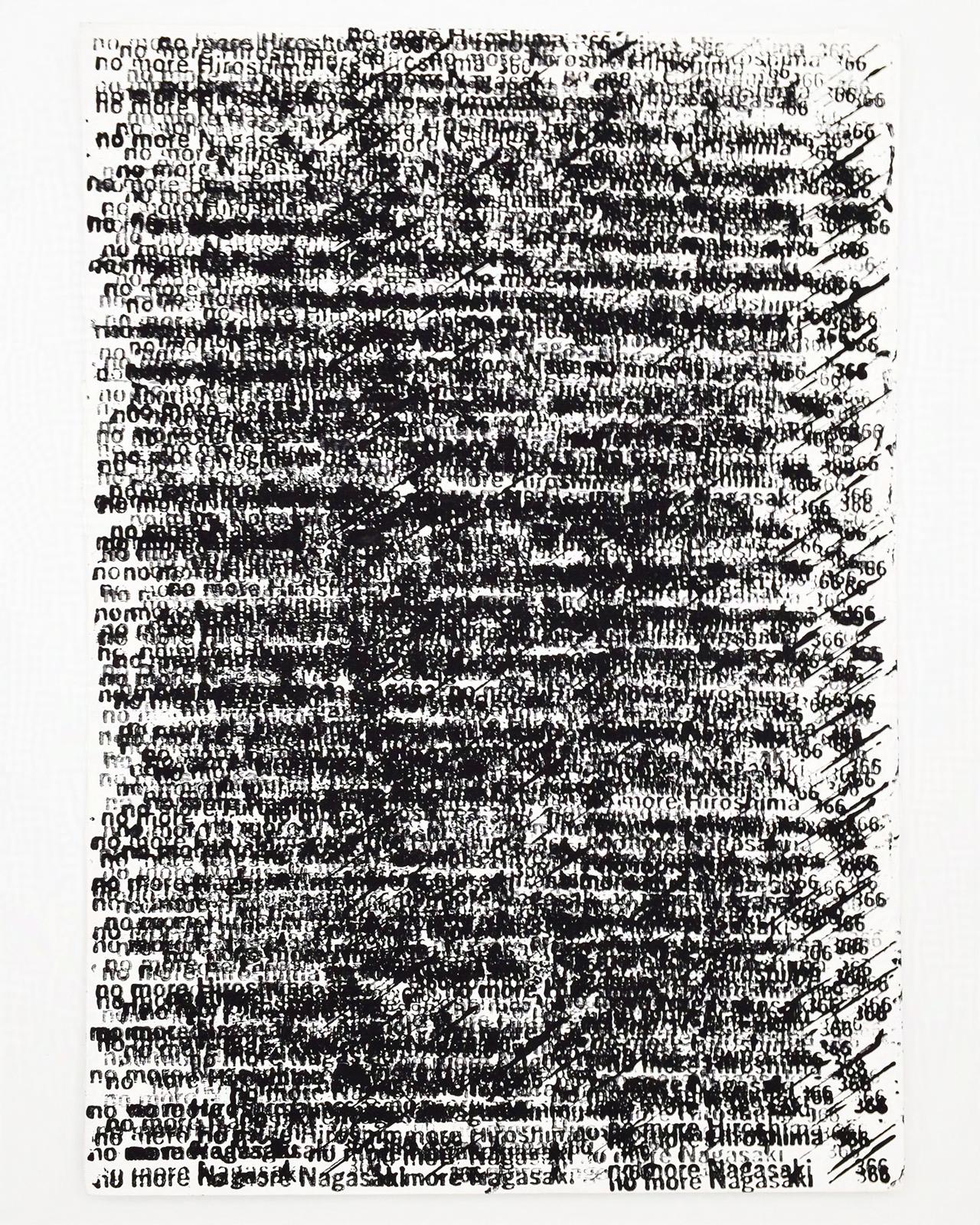
What Is the 366 Days Project?
As part of my “No More Hiroshima, No More Nagasaki 366/366” series, I am working on something called the 366 Days Project.
Every day, I make some kind of change to a single artwork and post it online.
For 366 days.
And now, I’m in my fourth year.
To be honest, I have absolutely no long-term plan. I have no idea how long I’ll keep doing this or what I ultimately want to do with it.
I started it on a sudden, powerful impulse. I just felt an overwhelming urge to do it.
What Inspired Me: Returning to Hiroshima Peace Memorial Park for the First Time in Nearly 30 Years
I started this project in May 2023.
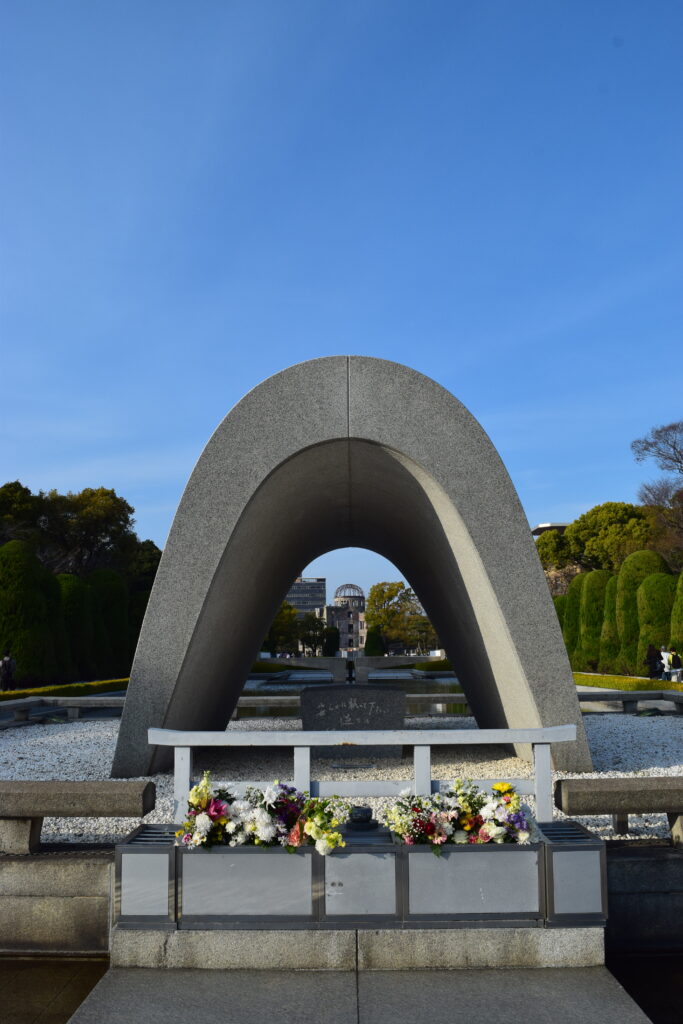
That spring, I spent three days in Hiroshima, with a visit to Hiroshima Peace Memorial Park as my main reason for going.
It was the first time I had been there in nearly 30 years, since my high school trip.
At the beginning of 2023, I had started taking concrete steps toward expressing myself more fully through art.
At the same time, I strongly felt that I needed to learn more deeply than ever about something that has always been a powerful driving force behind my artistic expression: my anger toward war and the struggle to take things from one another.
That was what made me decide to visit.
Still, as a Japanese person, why had I stayed away from this place for so long?
It was because the shock I experienced when I visited the Hiroshima Peace Memorial Museum on my high school trip had stayed with me, vividly, all those years.
To be honest, it was traumatic.
I was scared.
The museum back then was different from what it is today.
There were incredibly realistic human figures that vividly recreated what people had looked like in the aftermath of the atomic bombing.
(Of course, I imagine the actual reality was far, far, far worse.)
Back then, I was just an ordinary high school student, caught up in the excitement of a school trip—a chance to experience something out of the ordinary with my friends.
The museum was simply one of the scheduled stops, something we were expected to visit for educational purposes.
But the exhibits were so realistic that I couldn’t bring myself to look at them properly. I remember rushing through the museum with my friends at full speed.
And just how realistic were they?
So realistic that I could almost smell an overpowering stench just by looking at them.
What kind of smell?
The smell of a city burned to the ground, yes, but above all, the horrific smell of human bodies being burned.
Of course, I have never experienced anything like that myself. And those figures didn’t actually have any smell.
It was seeing them that somehow recreated that vivid, realistic smell in my mind.
Yes, it was a smell my own brain had conjured up.
The reality must have smelled far, far, far more horrifying.
And yet, after all those years, I suddenly remembered, with startling clarity, the world I had encountered as a child through the manga Barefoot Gen.
Naturally, I have no objection to the way the museum was designed back then.
Quite the opposite. I felt that I had been shown something incredibly important.
Thanks to that experience, even though I had never experienced war firsthand, I was able to internalize just how devastating its consequences could be.
And I was able to embrace a deep, righteous anger:
“We must never allow anything that causes this kind of suffering.”
That is why, for so many years, I never visited Peace Memorial Park, even when I found myself in Hiroshima Prefecture.
But this time, I had prepared myself.
I was going to look.
I was going to face it without turning away.
What I Felt When I Visited the Hiroshima Peace Memorial Museum
On the second day of my stay, I finally steeled myself and headed to the Hiroshima Peace Memorial Museum.
There were plenty of international tourists, too, and I joined the line and entered the museum.
But the museum I found was no longer the one I remembered.
Apparently, it had been renovated at some point.
I had no idea.
The interior was refined.
Everything was orderly.
Of course, I could feel the intention to communicate the horrors of the bombing.
But…
That intense feeling I had experienced as a high school student was completely absent.
As I made my way through the exhibits, I kept thinking that surely, somewhere, there would be a display of those human figures.
I had braced myself for it.
But I never saw them.
I felt strangely let down.
And at the same time, I was left with a feeling I couldn’t quite put into words.
So many people from overseas had taken time out of their trips to come here and see this place.
Was this beautiful, carefully arranged exhibition really what they had come to see?
Then again, they were in the middle of traveling.
If the figures had still been on display, the images might have stayed with them throughout the rest of their trip.
And yet…
At the exit, I filled out the visitor questionnaire.
I wrote:
“I was disappointed that the human figures were no longer on display. I imagine this was done out of consideration for children, but why not create a room that visitors could choose whether or not to enter?”
Later, I had an opportunity to speak with someone who had been born and raised in Hiroshima. I told them how disappointed I had been to learn that the figures had been removed.
They felt the same way.
They, too, thought it would have been better if the figures had remained.
They explained that one reason for removing them was that some people felt the exhibits were too distressing, especially for elementary school children.
That makes sense.
If you live in Hiroshima or a neighboring prefecture, you will probably visit the museum as an elementary or junior high school student.
At that age, those exhibits would be incredibly difficult to face.
I understand that very well.
Even as a high school senior, I had been terrified.
But I wonder whether, for people who visit when they are a little older, the museum could be a valuable place to experience the right kind of fear.
I believe that one of the few ways we can offer some measure of solace to those who lost their lives in war, and to those who were wounded in body and mind, is to build a world where nothing like this ever happens again.
And I believe this is something all of humanity should commit to together. It should go without saying.
With those powerful, deeply felt convictions renewed in my heart, I returned home.
And So, I Started the 366 Days Project
But even more than a month after visiting Peace Memorial Park, I still hadn’t taken any concrete action.
And there was another part of me that knew, absolutely, that I didn’t want to let things stay that way.
I wanted to give form to the feelings that had grown so strong in me after returning to Peace Memorial Park for the first time in so many years.
And so, on a sudden, overwhelming impulse, I decided to do something about it.
That was how this project began.
The thing is, I’m really bad at doing the same thing over and over again.
So when I started this project, I regretted it almost immediately.
Actually, I still regret it from time to time.
And yet, despite those regrets, I keep going.
Let me be honest about how this project actually works.
I don’t necessarily work on the artwork every single day and manually publish a new post every day.
Realistically, that would be a pretty high hurdle for me.
Although, when I first started, that was exactly what I intended to do.
But just a few weeks into the project, I found myself in a situation where I couldn’t get to a place where I had the time and space to work for several days in a row.
Should I take all the tools I needed with me whenever I went out and somehow find a way to post?
I considered it for a moment.
But when I thought about all the different things that might come up in the future, I realized that keeping the project going that way would be extremely difficult.
So I gave up on that idea.
Since then, I’ve been working on the artwork little by little, photographing the changes I’ve made, and posting them online.
At first, I felt very uncomfortable with this approach.
Wouldn’t I be letting down the people who were following the project?
That’s what I worried about.
But then I reminded myself of what I actually wanted to express through this project.
It wasn’t about demonstrating how to keep working steadily, day after day, without fail.
What I wanted was to create a moment every single day when I, first and foremost, would consciously think about war by sharing something online.
And I hoped that, by posting every day, I could also give other people a moment to think about war—even if it lasted only the briefest instant as they scrolled through their screens.
That was why I started this project.
Once I remembered that, I realized I wasn’t betraying the spirit of the project at all.
Still, I’m rather scatterbrained, so especially in the early days, there were a few times each year when a setting hadn’t been configured properly and a post simply failed to appear.
There were also days when I apparently posted the same thing twice because I thought I hadn’t set it up correctly in the first place.
The perfectionist in me would normally have declared the whole project ruined at that point.
That’s it. This artwork is finished!
And I would have stopped right there.
But life has thrown me into so many rough waters that I’ve grown a little thick-skinned.
So instead, I tell myself:
“Well, these things happen.
I’m only human.”
And somehow, I’ve managed to keep going, at least for now.
Oh, and I absolutely love the phrase:
“I’m only human.”
I think I’ll write about that another time, too.
And that, in a nutshell, is how the 366 Days Project came to be.
October 17, 2026
mienaimonotachi
みえないものたち
Hiroshima-Peace-Memorial-Park_Cenotaph-for-the-A-bomb-Victims-scaled